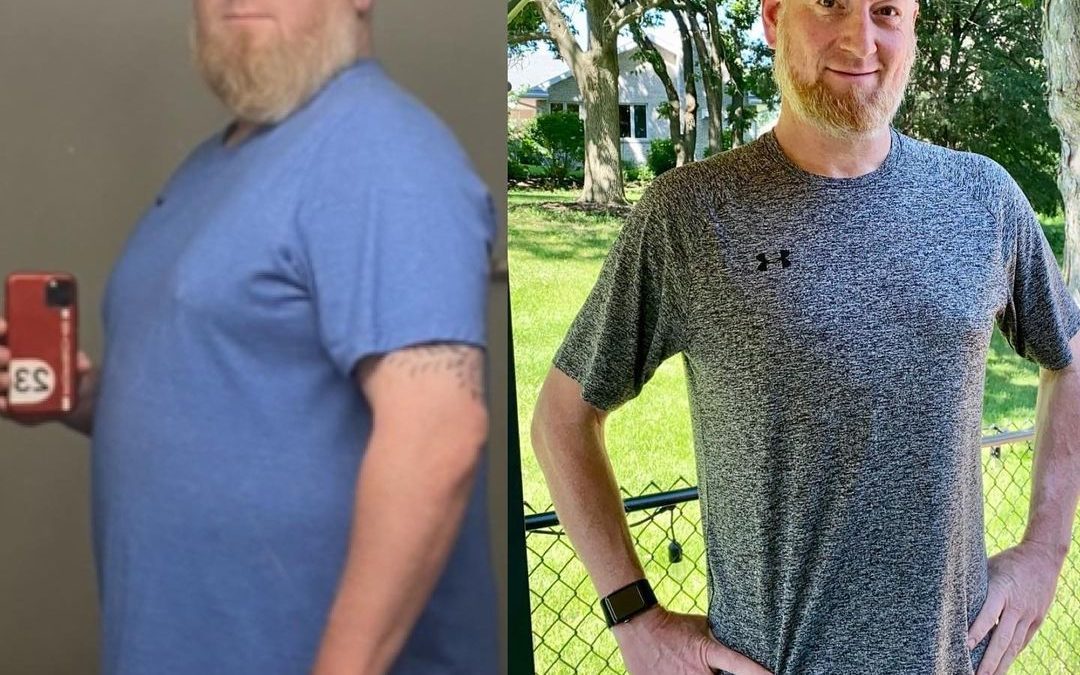
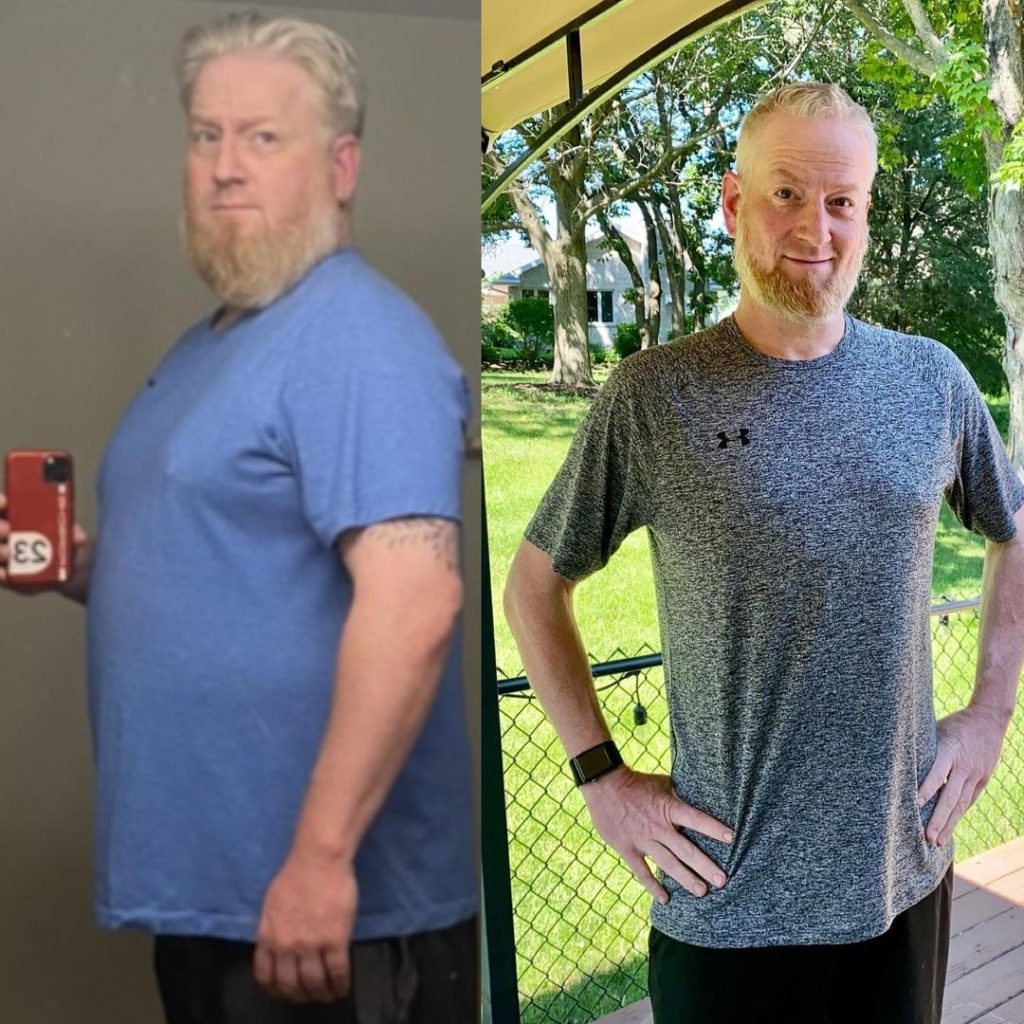
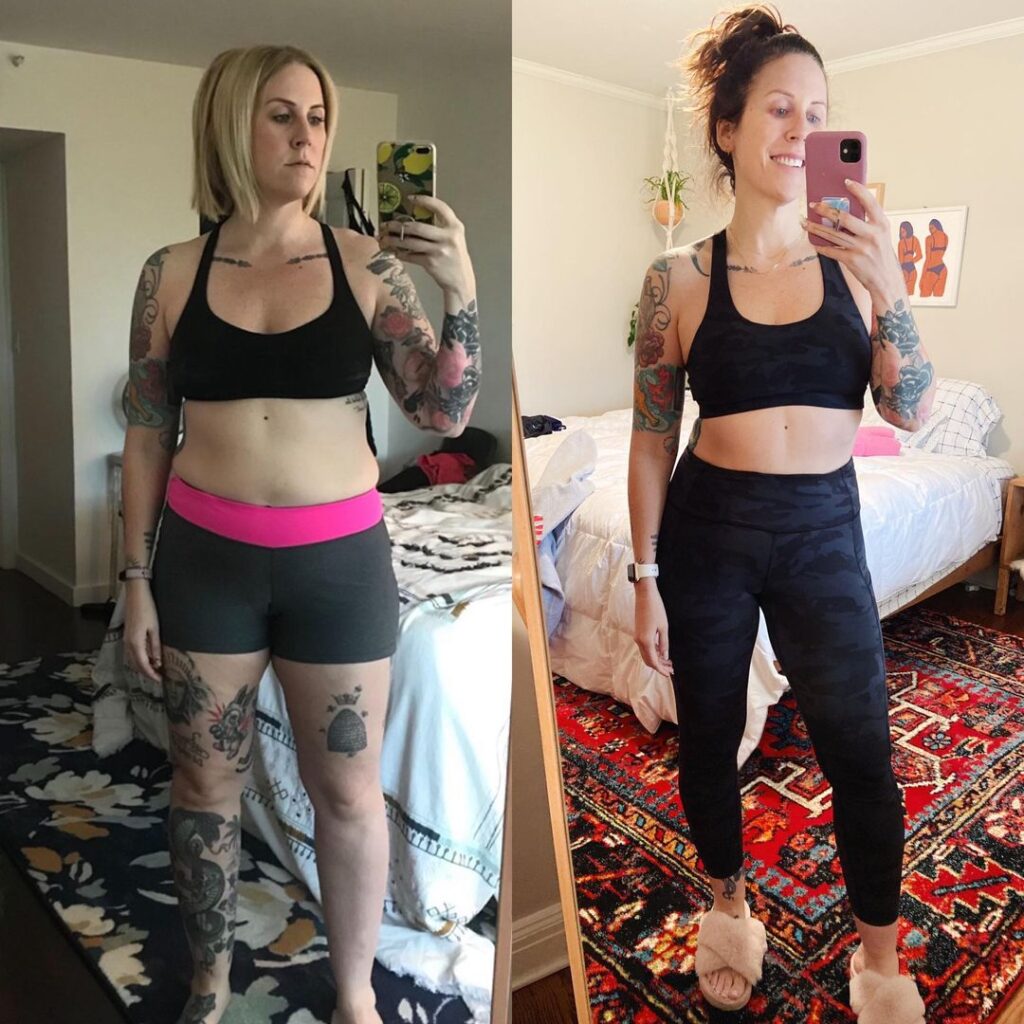
WOW! Chris lost 95 pounds in 6 months and is keeping it off!
How long did you wait before signing up for The Dan Plan?
I waited years, after knowing I needed a change, before finally signing up for it.
I waited 8 months before signing up for the Dan Plan, after knowing of it.
What had you tried before?
Unguided gym memberships and a half assed diets.
What were your overall results those programs?
Years of payments for things I wasn’t using, additional weight gain and pre-diabetes.
What would you say to someone on the fence about signing up?
There is no perfect time to start, life is too complicated to need the perfect window to address your own health and happiness.
Once the kid is older, once the job is easier, after I move to _, once _ season is over with – there’s always justifications to not do it now.
You can totally do this while juggling everything else in your life. You don’t have to think about what to do, just follow the guide and put in the work.
Getting your diet and exercise going on a nice routine seriously makes every other part of a complicated modern life easier to deal with both mentally and physically.
I couldn’t be on my feet for more than 10 minutes without wincing in pain, that’s where I allowed myself to get to before I hit ‘bottom’ enough to do something about it.
That sucks. Don’t keep pushing where ‘bottom’ is before starting the climb back out.
The only thing in the whole process that was truly hard, was knowing I could have done it sooner.
Fitness is about thriving in your natural environment. Thriving in your environment is different than getting by or winning gold medals. If you are a full time mom, banker, construction worker or engineer you will be happiest and perform the best when you are healthy. Nagging injuries are not indicative of health, or an effective exercise regime. It is my assertion that cardio respiratory endurance is the foundation of long term health and wellness and ultimately fitness.
It’s my belief that high-intensity exercise IS effective at creating athletic adaptations in certain cycles of training, but we are not always after athletic adaptations. Constant high intensity is used in manufacturing the world over, and it is called a stress test. The goal of a stress test is to find out when something will break. Exercising continuously at high intensity is the perfect method to find out when youwill break. We don’t want to break you, went you to be happy and healthy.
I definitely respect and enjoy watching people push the limits of human performance. Roger Bannister’s sub 4 minute mile, Usain Bolt’s 100 meter world record, Sonita Muluh’s 701 pound squat, Michael Phelps’ 18 olympic medals, Barry Bond’s 73 home runs in a season and Lance Armstrong’s 7 Tour de France victories are all amazing athletic achievements. These athletes would do whatever it took to break all records, or die trying. But we are not trying to die. We are trying to live long, full lives. So how? Well…
Fitness is about surviving and thriving in your natural environment. The greatest danger you face is cardiovascular disease. Statistically, it is most likely to be your cause of death. If fitness is about surviving and thriving in your environment we must first prioritize training methods in order to prevent preventable disease and look to live longer; live better.
Aerobic conditioning has advantages over anaerobic work as it can increase physical endurance and lifespan. Recovery between bouts of aerobic exercise is easier and faster than anaerobic sessions. During aerobic training, the aim is to improve blood flow to the lungs, heart, and blood vessels. Aerobic conditioning is a process where the heart and lungs are trained to pump blood more efficiently, allowing more oxygen to be delivered to muscles and organs.
Efforts below 85% maximum heart rate are considered aerobic, while anaerobic is considered anywhere above 85% maximum heart rate. The majority of favorable adaptations come between 60 and 80% maximum heart rate.
Faster is not better. As long as you get your heart rate into the target range, running a 12-minute mile or six-minute mile produces approximately the same aerobic and caloric effect. A minimum of four weeks is generally required to build an aerobic base. For those of us that have trained ‘hard’ for some time, doing these sessions can seem boring and mundane, however the results from doing these sessions will replace the creeping thoughts of boredom.
I encourage you to wear a heart rate monitor as it helps you more accurately measure your level of exertion. This will be your most effective path to aerobic fitness, much better than an RPE scale or guessing. If you don’t have a heart rate monitor, get one. Until then, use our 3 level scale.
Level 1 – “Talking” pace – You can hold a conversation while running/biking/rowing etc. You are able to talk in complete sentences. “Talking” pace is considered Zone 1 & 2. This is approximately 50-75% of your Maximum heart rate. This is used for recovery work, or long slow distance (LSD) for weight loss. This has the lowest impact physiologically, and these workouts could be performed nearly every day without overtraining or injury.
Level 2 – “Race pace” – You are able to maintain this pace for a long time, but would be unable to hold a conversation while doing so. You can say a word or two but are unable to speak in complete sentences. “Race pace” is between 75-85% of your maximum heart rate, or Zone 3 & 4. This would be considered a race pace. You could not comfortably speak, but could keep this pace up for the duration of a 5k or 10k race.
Level 3 – “The Burn” – You literally feel your muscles begin to burn. You are unable to speak without it diminishing your effort. “The Burn” is when you have surpassed 85% of maximum heart rate, Zone 5. You are now performing the majority of metabolism through the anaerobic energy systems. You literally feel your muscles burning, and you can not keep this type of effort up for more than 2 minutes without an extraordinary mental effort.
In order to exercise in the most effective possible way, the best program will consist of a majority of work in the 60-80% heart rate range, with small, short bursts and specific sessions near the lactate threshold. These bursts will generally be under 2 minutes in duration, and volume and intensity should be tightly controlled to make sure that over training is kept in check. Overtraining is associated with persistent fatigue, decreased performance, prolonged muscle soreness, poor sleep & recovery and frequent illness.
I encourage you to spend some time working on your endurance and see how it affects your other training and activity. Spend a month doing 3 sessions a week of lower intensity. You can still lift and there is no rule that says what type of training or movement you have to do. It doesn’t need to be a boring treadmill effort (though it can be); it can be a mix of bodyweight, kettlebells, dumbbells, jump rope…the possibilities are endless. You’re only limited by your heart rate. You can still do higher intensity on other days and still see the payout.
The general formula for max heart rate (HR) is 220 minus your age, though this will vary depending on training background, health history and recovery state on the day of your training. For an Average Joe or Jane that’s 50 years old, their hypothetical max HR will be 170 and percentages would be based off of this. 70% max HR is usually considered the sweet spot for aerobic training and 40 minutes is thought to be an ideal time for adaptation, though trainees can increase this as their fitness improves or decrease this if they’re new to training or making a comeback.
So, the plan looks like this for a 50 year old looking to gain aerobic fitness (adjust HR to your age):
On Monday, Wednesday & Friday do 10 minutes of ramping up to a HR of 120+/-bpm, 20 minutes at 120+/-bpm and 10 minutes winding your HR back down. This can be done after a core lift or a couple of supersets if desired. You can bike, jog, row, ski, echo bike, jump rope, walk, dance, box -whatever makes you happy – just keep your HR at around 70 percent and reap the benefits.
For those that are used to daily hard efforts, this will be difficult to do as they are used to a higher level of exertion and may chase the high that comes with near-max training. Avoid this. Save it for other days and be patient. I really think you’ll like what you get from this type of training.
According to the USDA, I (a 6’3″, 205 pound ‘Very Active’ male) should get the following:
Carbohydrate: 436 – 630 grams
Protein: 71 grams
Fat: 86 – 151 grams
Water: 3.7 Liters (about 16 cups)
While I’m not mad at the 630 grams of carbs suggested, I think it may be a bit of overkill, and I know from personal experience that 70 grams of protein is going to make me feel like a flaccid, limp bag of protoplasm. I think they almost nailed the water intake. Good job USADA. Whups…USDA. Same thing? One tests for dope, one gives dopey nutrition advice.
More protein!
Moving on:
“Elevated protein consumption, as high as 1.8-2.0 g · kg(-1) · day(-1) depending on the caloric deficit, may be advantageous in preventing lean mass losses during periods of energy restriction to promote fat loss.”
That sounds closer to the truth for me. Around 150-175g of PRO a day and I recover well, move well and feel alive! If I slip and forget to keep intake up on a training day, I feel it. As I get older, more and more…
Which brings me to:
As we age, the habitual intake of high quality protein in servings of 25-30g at breakfast, lunch and dinner may delay sarcopenia, or the loss of muscle due to aging.
Ingesting enough protein may prevent the onset of sarcopenia.
Simply stated: get enough to feel good. If you train hard 1.8 – 2g per kg of body weight is a safe bet. If you don’t train hard, get a little less. As you age, keep getting it and maybe even more. If you train hard, get more to rebuild and recover.
In early 2006 I was about to turn 30 and was “working” full time as a DJ and producer. Late nights, lots of free open bar tabs and too much travel. The lifestyle was beating me down. I was looking for paths of physical and mental improvement. I knew I needed to become a better human.
I started reading again, and I hired a trainer at the small independent bodybuilding gym on the Upper Eastside of Miami. Idol’s Gym. It was a mix of juiced up semi-pro bodybuilders, buff gay dudes in grey sweatpants, pre-influencer Miami-fit mamas and randoms from the neighborhood. I fell into the randoms department.
The first session I trained I excused myself 5 minutes in and ran to the toilet. I had explosive diarrhea for 20 minutes. Sorry, TMI – I know, but it’s reality. That was the end of our half hour session. The second session I made it all the way through the half hour, but went home with a raging headache. My body was rebelling.
Thankfully, I had written a check for $1500 (close to $2500 in today’s money) and was not going to quit and lose the cash. It was honestly more than I could afford, but I had committed to a bunch of sessions and I had to at least keep trying. By the 5th session I was hooked. By the 40th session, the trainer cut me loose.
“I’ve never trained anyone that works as hard as you do, I need to take on a new client, you’re on your own now. You can do it,” he said with the same calm confidence he’d used when he showed me the book he’d published with his boyfriend that was workouts and meal plans mixed with black and white photos of them working out in speedos.
So…
off I went.
I’m not sure exactly when or how, but I had somehow run into Ross Enamait’s books and had become hooked on his low equipment, high intensity workouts. Double-unders, ab wheel roll outs, weighed strict pull ups, heavy dumbbell snatches, burpees and sprints. Mile repeats, swimming intervals, bike sprints.
I loved it.
One day I was working myself into the ground in a weight vest with stair runs, burpees and abs into oblivion.
The owner came up to me. Barbara Streisand was on the stereo. I had DJ’d Purdy Lounge in South Beach in a 3M mask (cigarette smoking was still allowed) until 4:30am, it was now 2pm and no one else was in the usually busy gym.
“What in the hell are you training for?” The ex-bodybuilder turned burnt out gym owner asked.
“LIFE MAN!” I shouted between weight vest constricted breaths as I went up and down the 13 wooden stairs it took to get to the ‘functional training’ mezzanine.
Punching bags, open floor space, a squat rack with a pull up bar, some random dumbbells. A bench.
The only real issue with the gym was the run route took you through the courtyard of a ficus covered courtyard occupied by a very hip, very Miami restaurant. Early enough, you can run before they open. Too late – well, that’s one of the reasons we eventually moved on.
Anyway, life; man – that’s what I’m training for. Life. More of it. Lived Better.
I knew I wanted out of the late nights and traveling of a life in music. I’d returned home from a 6 week stint in Europe and my 2 year old daughter was not pleased. It broke my heart and I felt the wave come over me. I needed change; and I was pretty sure I knew where that change was going to happen.
This road was leading to one place…my own space, my own gym, my own thing.
First of all, prepare for a mouthful of research data. Without it, anything I say won’t matter. Anecdotes and instagram posts about fat loss carry about as much weight as a balloon (no water balloons allowed). Before getting too deep into this, let me be clear – exercise is very important to longevity and health for a large range of factors. Six pack abs won’t make you happy, but working out can certainly release hormones that make you happier, and the side effects of having a good body image can work wonders.
So yes, there are best practices for exercise to maximize fat burning when done with consistency.
Lets dig in…
In a study published in and reported by The New York Times, overweight men and women who exercised six days a week lost weight; those who worked out twice a week did not.
Current recommendations state that exercise programs should be over 225 minutes a week to induce clinically significant weight loss; however, in the study the average weekly exercise time for all participants was just over 249 min, producing nonsignificant decreases in percent body fat loss. The 6 day a week group exercised more than 320 minutes a week to experience significant decreases in body fat. Therefore, the results of the present study suggest current recommendations for exercise to promote weight loss may be inadequate and should be closer to 300 min·wkto overcome the approximately 1000 calorie compensation compensatory response that accompanies exercise.
A 2010 study stated that the effect of regular aerobic exercise on body fat is negligible; however, other forms of exercise may have a greater impact on body composition. For example, emerging research examining high-intensity intermittent exercise (HIIE) indicates that it may be more effective at reducing subcutaneous and abdominal body fat than other types of exercise. (1)
Exercisers can burn slightly more body fat with interval training than moderate-intensity continuous training, according to a recent systematic review and meta-analysis in the British Journal of Sports Medicine. Although the differences in fat loss weren’t huge, the interval workouts were shorter, which could make it easier for people to adhere to them.
One very underappreciated fact about exercise is that even when you work out, those extra calories burned only account for a tiny part of your total energy expenditure.
“In reality,” said Alexxai Kravitz, a neuroscientist and obesity researcher at the National Institutes of Health, “it’s only around 10 to 30 percent [of total energy expenditure] depending on the person (and excluding professional athletes that workout as a job).”
A study, published in the International Journal of Sport Nutrition & Exercise Medicine, involved 73 healthy adults aged 19-63 (41 men; 32 women). It tested the lifestyle and biological factors for optimal fat burning by asking participants to take part in a cycling fitness test and measuring key indicators.
Their results found that females and those who were physically fitter, right across the age ranges, burnt fat more efficiently when exercising. Basically, if you’re already fit, you have optimized yourself into a fat burning machine. It should also be noted that in order to achieve fitness, one has to abide by a relatively healthy diet.
In another study, to determine the effects of a 15-week high-intensity intermittent exercise (HIIE) program on subcutaneous and trunk fat and insulin resistance of young women, subjects were randomly assigned to one of the three groups: HIIE (n=15), steady-state exercise (SSE; n=15) or control (CONT; n=15). HIIE and SSE groups underwent a 15-week exercise intervention. The subjects were forty-five women with a mean BMI of 23 and age of 20.
Both exercise groups demonstrated a significant improvement in cardiovascular fitness. However, only the HIIE group had a significant reduction in total body mass, fat mass, trunk fat and fasting plasma insulin levels. There was significant fat loss in legs compared to arms in the HIIE group only. Lean compared to overweight women lost less fat after HIIE.
Yet another study results in mice and humans show that in response to mechanical loading, muscle cells release particles called extracellular vesicles that give fat cells instructions to enter fat-burning mode.
John McCarthy, Ph.D., study author and associate professor in the UK Department of Physiology says,
“To our knowledge, this is the first demonstration of how weight training initiates metabolic adaptations in fat tissue, which is crucial for determining whole-body metabolic outcomes. The ability of resistance exercise-induced extracellular vesicles to improve fat metabolism has significant clinical implications.”
It should be noted that there is very strong evidence that self reporting of food intake fails and almost everyone undercounts.
Research examining the effects of HIIE has produced preliminary evidence to suggest that HIIE can result in modest reductions in subcutaneous and abdominal body fat in young normal weight and slightly overweight males and females. Studies using overweight male and female type 2 diabetic individuals have shown greater reductions in subcutaneous and abdominal fat. Basically, if you’re overweight or obese, you’ll lose fat quicker, a fact I have seen in practice time and time again.
The mechanisms underlying the fat reduction induced by HIIE, however, are undetermined but may include HIIE-induced fat oxidation during and after exercise and suppressed appetite. Regular HIIE has been shown to significantly increase both aerobic and anaerobic fitness and HIIE also significantly lowers insulin resistance and results in increases in skeletal muscle capacity for fatty acid oxidation and glycolytic enzyme content.
So, now that we have the science – what does this all mean? Well, short bursts of intense exercise repeated with short rest breaks can really work wonders. Studies have been done with as little as 3 minutes of alternating 6 seconds of maximum intensity followed by 9 seconds of recovery. Mind you, these tests are done on high level athletes and most humans cannot perform at this level.
For most people, doing things like 20 seconds of intense cardio followed by 40 seconds of rest for 10 sets can do a lot. When applied with a superset or two of strength work (a formula I use is two alternating exercises done as an every minute on the minute set (EMOM)) you can get a fantastic fat burning workout in 10 minutes.
NOW – while I have stated that low level aerobic work does not do a lot for fat burning, it can do a lot for many other parts of your life. Walking does help maintain muscular and skeletal mass, very important as we age. It can also do good things for our emotional and mental well being. Just getting out and moving is important and should be prioritized.
Finally, and most importantly, no exercise routine is nearly as important as your routine with food. Without a structured plan for eating, you’ll be rowing in circles with one oar. The real magic bullet for fat loss is not exercise, it’s nutrition, sleep and exercise put together. You cannot have one without the other and hope for results – especially as we age.
All that said, it is important to work out and do something you enjoy. If you want some help with your specific plan, reach out. I pay a coach to write my workouts based on my current goals. Even as a professional trainer, I love the ability to login to an app and be told what to do to reach my goals. It also holds me accountable because I know once a month my coach will look at my workouts and progress. He won’t get mad if I don’t do something, but he will give me a, “ what the heck – i thought you cared about this stuff!” …and I do, and then I do better, not perfect.
PLEASE!
Sign in for classes – if there is no space in class, please sign in for another class. We are doing our best to meet your needs and keep everyone safe so we can all continue to enjoy training. Thank you!
—
Please do not spray barbells or rower computers with bleach, spray the paper towel then wipe the bar/computer. We are trying to prevent excess rust and wear and tear. Thanks!
—
305
M-F – 6am, 7am, 8am, 11am | 5 & 6pm
A1A
M-F – 6am, 7:00am, 8:30, 10:30am | 6 & 7pm
Weekends – 9 & 10am @ both
—
😁
Zoom
M-F – 6am, 8am, 9:30am, 6pm EST
Sat – 9am
https://zoom.us/j/679368832
—
Dec 24th – morning classes, no evening
Dec 25th – CLOSED
Dec 26th – Normal Schedule resumes
Dec 31st – morning classes, no evening
Jan 1st – CLOSED
Jan 2nd – Normal Schedule resumes
—
Kids classes every Monday at 4pm with Coach Keenan!
Please fill out this waiver for each child:
bit.ly/305waiver
Cost is $89 per child for 4 classes
—
pace is goal 5 mile pace -20 seconds/ mile. so if your goal 5 mile pace is an 8:00 mile(2:00 400m) your goal pace for this would be 7:40 mile or 1:55 400m.
PLEASE!
Sign in for classes – if there is no space in class, please sign in for another class. We are doing our best to meet your needs and keep everyone safe so we can all continue to enjoy training. Thank you!
—
Please do not spray barbells or rower computers with bleach, spray the paper towel then wipe the bar/computer. We are trying to prevent excess rust and wear and tear. Thanks!
—
305
M-F – 6am, 7am, 8am, 11am | 5 & 6pm
A1A
M-F – 6am, 7:00am, 8:30, 10:30am | 6 & 7pm
Weekends – 9 & 10am @ both
—
😁
Zoom
M-F – 6am, 8am, 9:30am, 6pm EST
Sat – 9am
https://zoom.us/j/679368832
—
Dec 24th – morning classes, no evening
Dec 25th – CLOSED
Dec 26th – Normal Schedule resumes
Dec 31st – morning classes, no evening
Jan 1st – CLOSED
Jan 2nd – Normal Schedule resumes
—
Kids classes every Monday at 4pm with Coach Keenan!
Please fill out this waiver for each child:
bit.ly/305waiver
Cost is $89 per child for 4 classes
—
PLEASE!
Sign in for classes – if there is no space in class, please sign in for another class. We are doing our best to meet your needs and keep everyone safe so we can all continue to enjoy training. Thank you!
—
Please do not spray barbells or rower computers with bleach, spray the paper towel then wipe the bar/computer. We are trying to prevent excess rust and wear and tear. Thanks!
—
305
M-F – 6am, 7am, 8am, 11am | 5 & 6pm
A1A
M-F – 6am, 7:00am, 8:30, 10:30am | 6 & 7pm
Weekends – 9 & 10am @ both
—
😁
Zoom
M-F – 6am, 8am, 9:30am, 6pm EST
Sat – 9am
https://zoom.us/j/679368832
—
Dec 24th – morning classes, no evening
Dec 25th – CLOSED
Dec 26th – Normal Schedule resumes
Dec 31st – morning classes, no evening
Jan 1st – CLOSED
Jan 2nd – Normal Schedule resumes
—
Kids classes every Monday at 4pm with Coach Keenan!
Please fill out this waiver for each child:
bit.ly/305waiver
Cost is $89 per child for 4 classes
—
Schedule for Thanksgiving week Mon Nov 23-Sun Nov 29th
Mon-Wed REGULAR SCHEDULE
Thursday-Sunday 9&10 AM BOTH LOCATIONS
Zoom 9:30 Thursday & Friday
No Zoom Saturday & Sunday
—
305
M-F – 6am, 7am, 8am, 11am | 5 & 6pm
A1A
M-F – 6am, 7:00am, 8:30, 10:30am | 6 & 7pm
Weekends – 9 & 10am @ both
—
😁
Zoom
M-F – 6am, 8am, 9:30am, 6pm EST
Sat & Sun – 9am
https://zoom.us/j/679368832
—
Please be mindful of the following guidelines that must be followed:
-Please wear a mask
-Please bring a towel or two (one for the floor, one for drying off)
-Please wait until the Coach welcomes you in
-Please wash your hands upon entry & before leaving
-Please take all of your belongings to your station & clean EVERYTHING after
—
Weekends – 9 & 10am @ both
—
😁
Zoom
M-F – 6am, 8am, 9:30am, 6pm EST
Sat & Sun – 9am
https://zoom.us/j/679368832
—
Please be mindful of the following guidelines that must be followed:
-Please wear a mask
-Please bring a towel or two (one for the floor, one for drying off)
-Please wait until the Coach welcomes you in
-Please wash your hands upon entry & before leaving
-Please take all of your belongings to your station & clean EVERYTHING after
—